Introduction
Choosing between residential vs inpatient mental health treatment can feel confusing because both involve staying at a treatment facility and receiving around-the-clock support. However, they are not the same level of care.
The biggest difference is the purpose of treatment. Inpatient psychiatric care is generally designed for people who need immediate safety, medical monitoring, and stabilization during an acute mental health crisis. Residential treatment provides 24-hour structured support in a less hospital-like environment and usually focuses on longer-term therapy, recovery skills, and improving daily functioning.
For someone trying to choose care for themselves or a loved one, the most important question is not which program sounds more comfortable. It is which level of care safely matches the person’s current needs.
Residential vs Inpatient Mental Health Treatment at a Glance

Both treatment settings can provide 24-hour care, professional support, therapy, and medication management when appropriate. The major differences involve clinical intensity, safety requirements, environment, treatment goals, and expected length of treatment.
| Factor | Inpatient Mental Health Treatment | Residential Mental Health Treatment |
|---|---|---|
| Main purpose | Immediate safety and psychiatric stabilization | Ongoing therapeutic treatment and functional recovery |
| Typical setting | Hospital or psychiatric hospital | Residential, campus-style, or home-like treatment setting |
| Medical intensity | Higher | Usually lower than hospital inpatient care |
| Supervision | 24-hour monitoring and clinical support | 24-hour structured support and supervision |
| Best suited for | Acute or severe situations requiring hospital-level care | People needing more support than outpatient care but not necessarily acute hospital care |
| Treatment focus | Stabilizing severe symptoms and managing immediate risk | Therapy, coping skills, routines, recovery, and longer-term progress |
| Length | Commonly shorter | Commonly longer |
| Environment | More clinical and controlled | Generally more therapeutic and community-oriented |
| Transition | Often followed by another level of treatment | Often followed by PHP, IOP, or outpatient treatment |
These are general distinctions rather than universal rules. Programs can differ considerably in staffing, admission criteria, services, restrictions, and length of stay. A clinical assessment is therefore more reliable than choosing a program based only on its label.
What Is Inpatient Mental Health Treatment?
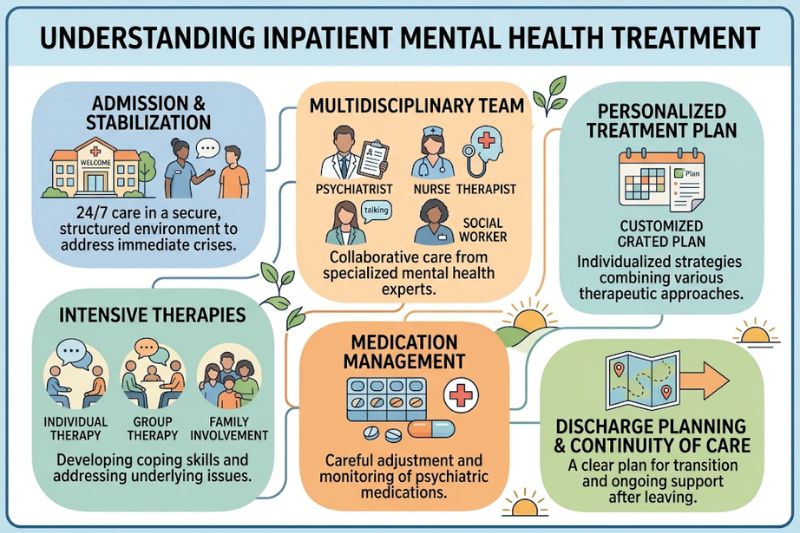
Inpatient mental health treatment is hospital-level psychiatric care in which a person is admitted and remains at the facility while receiving 24-hour treatment and monitoring.
SAMHSA describes inpatient treatment as staying overnight at a hospital or treatment program, usually for people who need 24-hour care for mental health or substance-use concerns. Medicare similarly describes inpatient mental health care as treatment received after admission to a general or psychiatric hospital.
The immediate objective is usually stabilization rather than long-term rehabilitation.
A person may require this level of treatment when their symptoms have become so severe that safe management in a less intensive setting is difficult or inappropriate.
Examples may include situations involving:
- Immediate danger of self-harm or harm to someone else
- Severe suicidal symptoms requiring urgent protection
- Psychosis accompanied by serious safety concerns
- Severe mania with dangerous or highly impaired behavior
- Serious inability to care safely for basic needs
- Mental health symptoms complicated by medical problems requiring hospital resources
- A psychiatric crisis requiring rapid evaluation, medication management, or close observation
ADAA describes inpatient units as appropriate when a person is experiencing a psychiatric episode that creates significant safety concerns, with treatment primarily aimed at safety and stabilization.
What Happens During Inpatient Psychiatric Treatment?
Treatment varies according to the hospital and the person’s needs, but inpatient care can involve a multidisciplinary clinical team.
Care may include:
- Psychiatric evaluation
- Nursing supervision
- Safety monitoring
- Medication evaluation and management
- Individual or group therapeutic activities
- Crisis intervention
- Medical assessment when necessary
- Discharge and follow-up planning
The environment is generally more controlled than a residential program because the facility must be able to manage people experiencing significant psychiatric instability.
That does not mean every person admitted to an inpatient psychiatric unit has exactly the same symptoms or level of risk. Admission decisions are based on individual clinical circumstances.
What Is the Main Goal of Inpatient Treatment?
The central goal is typically to make an acute situation safe and stable enough for treatment to continue at an appropriate lower level of care.
For example, someone experiencing severe psychiatric symptoms may first enter a hospital where clinicians can monitor safety, evaluate medications, and stabilize the immediate crisis. Once hospital-level monitoring is no longer required, that person might transition to residential treatment, a partial hospitalization program, an intensive outpatient program, or standard outpatient care.
This is why inpatient hospitalization should not automatically be viewed as a complete course of long-term mental health treatment. For many patients, it is one stage within a broader continuum of care.
What Is Residential Mental Health Treatment?
Residential mental health treatment is a live-in form of structured behavioral health care provided outside the traditional acute hospital setting.
A person lives at the program rather than returning home after daily treatment. Support is available around the clock, while the treatment environment generally allows more time for therapy, skills practice, routines, and gradual improvement.
SAMHSA distinguishes residential treatment from inpatient treatment by describing residential care as living at a treatment program, with stays that can extend from weeks to months depending on the type of program and the person’s condition.
Residential treatment may be considered when a person needs a highly structured environment but does not require the same hospital resources used for an acute psychiatric emergency.
This can create an important middle ground for someone who is struggling too much for ordinary outpatient therapy but is sufficiently stable to participate in longer-term therapeutic treatment.
What Happens in Residential Mental Health Treatment?
Residential programs differ considerably, but treatment may combine structured daily living with multiple forms of clinical support.
Depending on the program, care can include:
- Individual psychotherapy
- Group therapy
- Psychiatric services
- Medication management
- Family involvement
- Psychoeducation
- Coping-skills training
- Emotional-regulation work
- Daily routines and structured activities
- Social and interpersonal skill development
- Planning for life after treatment
The goal is generally broader than controlling an immediate crisis. Residential care gives people an opportunity to work on the patterns, symptoms, behaviors, and functional problems affecting everyday life.
A person might, for example, be medically stable but still unable to maintain normal routines, participate successfully in work or school, manage symptoms at home, or make progress through weekly therapy alone. Residential care can provide a more immersive treatment environment without requiring acute hospitalization.
7 Key Differences Between Residential and Inpatient Mental Health Treatment
Understanding the distinction becomes easier when the two options are compared according to what actually changes the clinical experience.
1. Inpatient Care Focuses More on Acute Stabilization
The clearest difference is the reason someone enters treatment.
Inpatient psychiatric care generally addresses an immediate or severe problem that requires hospital-level support. Residential treatment generally addresses continuing mental health needs after immediate safety can be maintained without that level of medical restriction.
ADAA describes safety and stabilization as primary inpatient goals, while residential treatment provides a longer therapeutic environment focused on continued treatment and functioning.
Consider two illustrative situations.
A person experiencing severe psychiatric symptoms and an immediate risk of harming themselves may require emergency assessment and inpatient hospitalization.
Another person may not be in immediate danger but may be struggling so severely with depression, trauma symptoms, anxiety, or another condition that living independently and attending occasional outpatient appointments is no longer enough. A residential assessment could be appropriate in that situation.
The diagnosis alone does not determine the level of care. Current symptoms, safety, functioning, medical needs, support system, and treatment history all matter.
2. Inpatient Treatment Is Usually More Medical
Inpatient psychiatric programs operate in hospitals or hospital-level psychiatric facilities where medical resources and close clinical monitoring are available.
Residential programs also employ mental health professionals, but the overall environment is generally less medically intensive.
This distinction matters when someone’s condition could change rapidly or requires interventions that a residential facility cannot safely provide.
For example, immediate psychiatric instability combined with serious physical-health concerns may require hospital resources before longer-term therapeutic treatment becomes appropriate.
3. The Physical Environment Is Different
A psychiatric inpatient unit is generally structured around safety, observation, and stabilization.
Residential treatment is usually structured around therapeutic living and sustained participation in treatment.
Residential programs may therefore feel more like a community or campus than a hospital. Residents may follow structured schedules involving therapy, meals, group activities, recreation, and skill-building.
Friends Hospital and other treatment providers similarly distinguish residential programs as generally more home-like and inpatient programs as more clinical and closely supervised.
The less clinical environment does not mean residential treatment is casual or unstructured. It can still involve intensive treatment throughout the week.
4. Residential Treatment Is Generally Longer
Length of stay is another major difference, although there is no universal number of days that applies to every patient or program.
Inpatient hospitalization tends to be relatively short because its primary purpose is to manage the immediate crisis and establish enough stability for the next stage of care.
Residential treatment generally lasts longer because meaningful therapeutic work, behavior change, skill development, and preparation for returning to everyday life take time.
SAMHSA notes that inpatient programs may involve overnight treatment for days or weeks, while residential programs commonly last weeks to months and may be longer for some serious conditions.
A person’s actual treatment duration can depend on clinical progress, program design, medical necessity, insurance authorization, family circumstances, and the discharge plan.
5. Daily Treatment Goals Are Different
A hospital team may ask:
What needs to happen for this person to become safe and medically or psychiatrically stable?
A residential team may focus more heavily on:
What needs to change for this person to function more successfully after leaving structured care?
That difference affects how treatment time is used.
Inpatient care may place greater emphasis on immediate assessment, monitoring, medication decisions, symptom control, and discharge preparation.
Residential care may allow more sustained work on coping strategies, emotional regulation, relationships, routines, triggers, communication, and the skills needed outside treatment.
Neither goal is inherently “better.” They address different stages and levels of need.
6. Freedom and Restrictions May Differ
Because acute inpatient psychiatric units treat people who may have serious safety concerns, these settings can have stricter rules around movement, belongings, visitors, and leaving the facility.
Residential environments are generally less restrictive, although specific rules vary widely between programs.
A residential treatment center still has clinical boundaries, schedules, safety policies, medication procedures, and expectations for participation. The difference is that those systems are usually designed around therapeutic residential care rather than acute hospital containment.
7. They Often Serve Different Points in the Recovery Process
Mental health treatment is better understood as a continuum of care rather than a choice between only hospitalization and weekly therapy.
Depending on the person’s needs, the continuum can include:
- Standard outpatient treatment
- Intensive outpatient programs (IOP)
- Partial hospitalization programs (PHP)
- Residential treatment
- Acute inpatient hospitalization
The exact ordering and services can vary by health system, but intensity generally increases as a person needs more structure, monitoring, or support. ADAA emphasizes that mental health levels of care differ according to factors such as frequency, intensity, duration, and environment.
This also means movement between levels is normal.
Someone could enter an inpatient hospital during an acute crisis, transition to residential treatment after stabilization, step down to PHP or IOP, and later continue with standard outpatient therapy. Another person may enter residential care without ever needing inpatient hospitalization.
The appropriate path depends on the individual’s clinical condition rather than following one mandatory sequence.
How to Know Which Level of Mental Health Care May Be Appropriate
The difference between residential and inpatient treatment is not simply about where someone sleeps. The right level of care depends on how severe the current symptoms are, how much supervision is needed, and whether the person can remain safe outside a hospital setting.
A professional assessment is usually needed to make that decision. SAMHSA notes that treatment plans are developed after healthcare professionals evaluate the person’s situation and needs.
Inpatient Care May Be More Appropriate When Immediate Safety Is the Concern
Inpatient psychiatric treatment may be considered when someone needs 24-hour hospital-level care because of an acute mental health crisis.
Examples can include:
- Serious suicidal thoughts or behavior
- Immediate risk of harming another person
- Severe psychotic symptoms affecting safety
- Extreme mood symptoms with significant impairment
- A psychiatric emergency that requires close monitoring
- A condition requiring medical resources that a residential program cannot provide
The exact admission criteria vary by facility and jurisdiction. A diagnosis by itself does not automatically mean someone needs inpatient care.
If there is an immediate danger of suicide, self-harm, violence, or a serious medical emergency, seeking emergency help is more appropriate than trying to decide between treatment programs online.
Residential Care May Be More Appropriate When Stability Has Been Established
Residential treatment may be considered when a person needs continuous structure and support but does not require acute hospital-level psychiatric care.
Someone might benefit from residential treatment when:
- Outpatient therapy has not provided enough support
- Symptoms interfere substantially with everyday functioning
- The home environment makes consistent treatment difficult
- The person needs a structured therapeutic routine
- More intensive therapy is needed over an extended period
- The person can participate safely without acute hospital containment
Residential treatment can therefore provide an important bridge between ordinary outpatient care and hospital-level treatment.
SAMHSA describes residential care as living at a treatment program, commonly for weeks to months, while inpatient care involves staying overnight at a hospital or treatment program for a shorter period such as days or weeks.
What Factors Determine the Right Level of Care?
There is no single checklist that can determine the correct treatment setting for everyone. Clinicians generally consider several factors together.
1. Safety
Safety is one of the most important considerations.
If someone presents an immediate danger to themselves or others, a hospital-based setting may be necessary. If the person is stable enough to participate safely in treatment but needs intensive structure, residential care may be considered.
2. Symptom Severity
The intensity and stability of symptoms matter.
A person with severe, rapidly changing psychiatric symptoms may need inpatient monitoring. Someone with significant but relatively stable symptoms may be able to participate in residential treatment.
3. Medical Needs
Mental health treatment sometimes involves physical-health concerns as well.
If someone requires medical observation, emergency intervention, or hospital resources, residential treatment may not provide an appropriate level of care.
4. Ability to Function Outside Treatment
Clinicians may also consider whether a person can safely manage basic daily responsibilities outside a structured setting.
For example, someone who repeatedly deteriorates when returning home may need more intensive support than traditional outpatient therapy can provide.
5. Previous Treatment Response
Treatment history can also influence the decision.
If weekly therapy and medication management have not been enough, a clinician may consider a more intensive level of care. That does not automatically mean hospitalization. Depending on the situation, options can include PHP, IOP, or residential treatment.
6. Available Support at Home
A stable and supportive home environment can sometimes make a lower level of care possible.
Conversely, living alone, having serious family conflict, lacking reliable support, or returning to an unsafe environment may make intensive structured treatment more appropriate.
Can Someone Move From Inpatient to Residential Treatment?
Yes. A person may transition from inpatient treatment to residential care when they no longer require acute hospital-level treatment but still need intensive, structured support.
This is one reason it is useful to think about mental health services as a continuum rather than as completely separate choices.
For example, a possible treatment pathway could look like:
Acute crisis → Inpatient stabilization → Residential treatment → PHP or IOP → Outpatient care
However, this is only one possible pathway.
Someone may enter residential treatment directly. Another person may leave inpatient care and return home with outpatient services. Someone else may need a different level of care altogether.
The transition should be based on clinical needs and a discharge plan rather than an automatic timeline.
SAMHSA recommends having a treatment plan that identifies what is being treated, treatment goals, and the next steps when receiving inpatient care.
Can Residential Treatment Turn Into Inpatient Treatment?
Yes. If a person’s condition becomes significantly worse and the residential program can no longer safely meet their needs, they may need evaluation for a higher level of care.
For example, a resident who develops an acute psychiatric crisis may require transfer to an inpatient psychiatric facility.
This possibility is one reason people should ask residential programs about their emergency procedures and relationships with nearby hospitals before admission.
A reputable program should be able to explain what happens if a resident’s clinical needs exceed the services it provides.
Residential vs Inpatient for Depression, Anxiety, PTSD, and Other Conditions
The diagnosis alone usually does not determine whether someone needs residential or inpatient care.
For example, depression can range from relatively mild symptoms managed through outpatient treatment to severe symptoms involving an immediate safety concern.
The same principle applies to anxiety disorders, PTSD, bipolar disorder, psychotic disorders, and other mental health conditions.
Two people with the same diagnosis can require very different levels of care because their symptoms, safety risks, medical needs, functioning, treatment history, and support systems may be different.
This is why the more useful question is not:
“Which program treats my diagnosis?”
It is:
“What level of support and supervision does my current condition require?”
What Should You Ask a Residential or Inpatient Program?
Before choosing a treatment facility, ask specific questions rather than relying only on the program’s marketing description.
Useful questions include:
- What level of care do you provide?
- What symptoms or situations qualify for admission?
- How is safety monitored?
- Is psychiatric care available around the clock?
- How often are patients evaluated by a psychiatrist or other qualified clinician?
- What therapy services are provided?
- How are medications managed?
- What happens during a psychiatric emergency?
- What happens if the person’s needs become too severe for the program?
- How is discharge planning handled?
- What treatment or support is recommended after discharge?
- Which costs are covered by insurance, if applicable?
These questions can reveal important differences between facilities that use similar labels.
A residential program with strong clinical services may look very different from another residential program with limited psychiatric availability. Likewise, inpatient units can differ in staffing, treatment programs, patient populations, and available services.
How Long Does Inpatient or Residential Mental Health Treatment Last?
There is no universal treatment length for either level of care.
Inpatient treatment is generally intended for acute stabilization and is often shorter than residential treatment. SAMHSA describes inpatient stays as commonly lasting a few days or weeks, while residential treatment commonly lasts a few weeks to a few months, with some programs serving people for substantially longer periods.
The actual length depends on factors such as:
- Clinical progress
- Safety
- Treatment response
- Medical needs
- Program requirements
- Insurance authorization
- Availability of appropriate follow-up care
- The person’s ability to function safely at the next level of care
A longer stay is not automatically better. The goal is to provide an appropriate level of support and transition to the next stage when clinically appropriate.
Does Residential Treatment Mean the Person Is Less Seriously Ill?
Not necessarily.
Residential treatment can be appropriate for people with significant and complex mental health needs who require intensive support but do not currently need acute hospital care.
The distinction is primarily about the level and type of care required, not a simple ranking of how “serious” someone’s diagnosis is.
A person can have a serious mental health condition and still be appropriate for residential treatment if they are stable enough to participate safely in that setting.
Conversely, someone with a condition that is commonly treated in residential programs may temporarily need inpatient hospitalization during an acute crisis.
What Happens After Residential or Inpatient Treatment?
Leaving a facility is not necessarily the end of treatment.
A strong discharge plan may identify:
- Follow-up psychiatric appointments
- Individual therapy
- Group therapy
- Medication management
- PHP or IOP services
- Family or caregiver support
- Community resources
- Crisis planning
- Relapse or symptom-management strategies
- Practical plans for returning to school, work, or home life
The appropriate next step depends on the person’s condition at discharge.
A useful treatment plan should therefore answer not only “Where do I go now?” but also “What support will I have after I leave?”
Common Mistakes When Comparing Residential and Inpatient Care
Choosing Based Only on the Facility’s Appearance
A comfortable environment can be valuable, but appearance should not be the main deciding factor.
Look at clinical staffing, services, safety procedures, admission criteria, and discharge planning.
Assuming Residential Treatment Is Always Less Restrictive
Residential care is usually less hospital-like, but programs still have rules and safety procedures. Policies vary considerably.
Ask for the actual program rules before making a decision.
Assuming Inpatient Treatment Provides Long-Term Recovery by Itself
Hospitalization can be essential for crisis stabilization, but many people need continued treatment after discharge.
The next stage may involve residential, PHP, IOP, outpatient therapy, medication management, or another service.
Choosing the Lowest Level of Care Simply Because It Feels Easier
A less intensive program is not necessarily the better choice if it cannot safely address the person’s needs.
The goal should be the least restrictive level that is also clinically appropriate and safe, rather than simply choosing the least intensive option.
Focusing Only on the Diagnosis
The same diagnosis can require different levels of care for different people.
Current symptoms, safety, functioning, medical needs, treatment history, and available support should all be considered.
FAQs
Is residential treatment the same as inpatient treatment?
No. Both involve living at a treatment facility, but inpatient treatment generally refers to hospital-level care for people who need 24-hour psychiatric treatment and stabilization. Residential treatment provides structured live-in care, commonly for longer periods, in a less hospital-focused environment.
Is inpatient mental health treatment more serious than residential treatment?
Inpatient treatment is generally more intensive from a medical and safety perspective, but that does not mean every person receiving residential treatment has a mild condition. Residential programs can treat people with substantial and complex mental health needs.
How long do you stay in residential mental health treatment?
Residential treatment can last from several weeks to several months, and some programs may provide longer-term care. The appropriate length depends on clinical needs and the specific program.
Can you go from inpatient to residential treatment?
Yes. A person may move from inpatient hospitalization to residential treatment after acute symptoms have stabilized if they still need intensive structured support.
Can you go directly to residential treatment without being hospitalized?
Yes. Hospitalization is not automatically required before residential treatment. If someone is stable enough for residential care but needs more support than outpatient treatment provides, a clinician may recommend residential treatment directly.
Which is better: residential or inpatient treatment?
Neither is universally better. Inpatient treatment is generally more appropriate for acute safety or medical stabilization, while residential treatment may be appropriate for people who need intensive ongoing support without hospital-level care.
What if someone is in immediate danger?
If someone may seriously hurt themselves or another person, or has another psychiatric or medical emergency, seek immediate emergency help rather than trying to select a residential program online. In the United States, calling or texting 988 connects people with the Suicide & Crisis Lifeline; for an immediate life-threatening emergency, call 911 or go to the nearest emergency department.
CONCLUSION
The key difference in residential vs inpatient mental health treatment is the level of clinical intensity and the problem the treatment is designed to address.
Inpatient care is generally focused on immediate safety, psychiatric stabilization, and hospital-level monitoring. Residential care provides a structured live-in environment for people who need intensive ongoing treatment but are stable enough not to require acute hospital care.
The best choice should be based on a professional assessment of current symptoms, safety, functioning, medical needs, treatment history, and available support.
Rather than asking which setting is “better,” ask which setting can safely provide the level of care needed right now. That approach makes the decision clearer and can help connect a person with the right treatment stage without treating inpatient and residential care as interchangeable.